
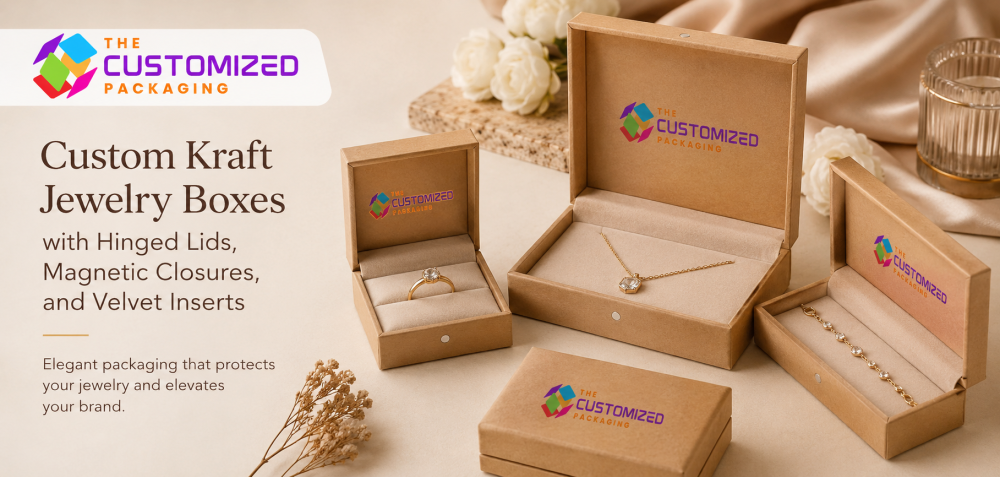
How to Design Kraft Jewelry Boxes with Hinged Lids, Magnetic Closures and Velvet Inserts
A hinged kraft jewelry box works best when the lid, magnetic closure and velvet insert are designed as one system. Learn how opening angle, magnet strength, insert height and jewelry clearance affect the final presentation.
 Published June 29, 2026
Updated August 31, 2026
13 min read
A hinged jewelry box may look simple from the outside, but its performance depends on several components working together.
The lid needs to open at the right angle. Concealed magnets need enough holding strength without making the box difficult to open. The velvet insert must position the jewelry securely while leaving sufficient clearance beneath the closed lid.
When these details are developed independently, problems can appear even if each component looks correct on its own.
Well-designed kraft jewelry boxes with hinged lids, magnetic closures and velvet inserts treat the structure as one complete presentation system.
Why These Three Features Need to Be Designed Together
The hinged lid, magnets and insert directly affect one another.
A thicker velvet insert raises the jewelry closer to the lid. A taller ring setting can reduce available clearance. Changing the board thickness can influence the position of concealed magnets, while a different magnet strength can change how the customer opens the lid.
That means the finished box should be evaluated with all three components installed.
The most important relationships are:
| Component | Main Function | What It Affects |
|---|---|---|
| Hinged lid | Controls opening and presentation | Viewing angle and top clearance |
| Concealed magnets | Holds the lid closed | Opening force and lid alignment |
| Velvet insert | Positions and cushions jewelry | Product height, stability and presentation |
| Kraft exterior | Creates the visible surface | Branding and overall visual character |
A successful box is not simply a kraft box with three premium features added to it. Each feature should support the others.
The Hinged Lid Controls the First View of the Jewelry
Unlike a lift-off lid, a hinged lid remains connected to the base.
When the box opens, the customer sees the jewelry and the inside of the lid at the same time. The opening angle therefore becomes part of the presentation.
If the lid falls too far backward, the box may feel unstable. If it stops too early, it can partially block the customer's view.
The right angle depends on the dimensions of the box, hinge construction and how the jewelry will normally be viewed.
A compact ring box may be presented close to eye level, while a larger necklace box may be viewed from above.
Lid Stability Matters During Presentation
A hinged box should remain open without requiring the customer to hold the lid.
This is particularly important when the box is used during:
-
Ring presentations
-
Jewelry gifting
-
Retail consultations
-
Product photography
-
Collection displays
A lid that continually closes or falls backward distracts from the jewelry.
Testing the complete box in its normal presentation position helps confirm whether the hinge behaves as intended.
Magnetic Closures Should Feel Controlled, Not Aggressive
Concealed magnets allow a hinged lid to close without visible tuck tabs or external fasteners.
The closing action should feel secure, but stronger is not always better.
If the magnetic pull is too weak, the lid may not remain properly aligned. If it is unnecessarily strong, opening the box can require more force than expected.
That extra force can also cause the customer to lift the entire box instead of opening only the lid.
A well-balanced magnetic jewelry box should release predictably with normal finger pressure.
Magnet Strength Depends on More Than the Magnet
The final closing action is influenced by:
-
Magnet size
-
Number of magnets
-
Magnet position
-
Board thickness
-
Kraft wrap thickness
-
Lid dimensions
-
Closure overlap
-
Box size
This is why magnet strength should be evaluated in the completed structure rather than judged from the magnet alone.
Even a small change to the board or wrap can affect the distance between the magnetic components and change the feel of the closure.
Magnet Placement Should Keep the Lid Aligned
The magnets should help the lid return to its intended closed position.
Poor placement can allow one edge to sit higher than the other or create an uneven gap around the box.
On wider jewelry boxes, the closure may need to control more than one point across the front edge.
The goal is not simply to keep the lid shut. The closed box should look properly aligned from the front and sides.
This becomes especially noticeable on minimalist kraft packaging because there are fewer decorative elements to distract from structural inconsistencies.
Velvet Inserts Change the Interior Height
A velvet insert affects more than the appearance of the box.
The foundation beneath the velvet may be made from foam, EVA, padded board or another fitted support. Each construction creates a different thickness.
That thickness determines how high the jewelry sits inside the base.
This makes lid clearance one of the most important checks when combining velvet interiors with hinged magnetic boxes.
The highest point of the jewelry should remain safely below the inside of the closed lid.
Measure the Jewelry at Its Highest Displayed Point
Jewelry dimensions should be measured in the position in which the product will actually sit inside the box.
For a ring, that means measuring the height of the setting after the ring has been placed into its insert.
For a bracelet, a raised charm or stone may become the highest point.
For a pendant, the gemstone or decorative centerpiece may sit above the surrounding chain.
The correct clearance is therefore based on:
insert height + displayed jewelry height + required lid clearance
rather than the jewelry dimensions alone.
This prevents a box from appearing suitable when empty but becoming too shallow once the finished insert and product are installed.
Ring Boxes Need Clearance Around the Setting
Rings demonstrate why the insert and lid cannot be designed separately.
The insert needs to grip the band securely enough to keep the ring upright. At the same time, it should not bury the setting so deeply that the most important part of the ring becomes difficult to see.
Raised stones also need enough space beneath the closed lid.
A physical sample should confirm that:
-
The ring remains upright
-
The setting does not touch the lid
-
The insert does not squeeze the band excessively
-
The ring is easy to remove
-
The magnetic lid closes without pressing on the jewelry
This is particularly important for engagement rings and designs with elevated settings.
Necklaces Need a Different Velvet Layout
A necklace usually requires a flatter, wider display surface.
The pendant should remain centered while the chain is controlled through discreet attachment points or concealed behind the insert.
A velvet-covered insert can create a clean visual background, but the attachment system should not make the necklace difficult to remove.
Excess chain also needs enough hidden space so that it does not create a visible lump beneath the velvet surface.
When the hinged lid opens, the pendant should become the main visual focus rather than a loose chain or attachment point.
Bracelets and Watches Need More Depth Control
Bracelets and watches have different three-dimensional profiles from rings and necklaces.
A fine bracelet may sit relatively flat, while a bangle, cuff or watch can occupy significantly more interior height.
Watch cushions in particular can raise the product close to the lid.
The interior should therefore be checked with the complete watch wrapped around its intended cushion.
For bracelets, the insert should support the natural shape of the piece without forcing it into an unsuitable curve.
The hinged box should close comfortably with the product fully loaded.
Choose Velvet Color Around the Jewelry
Velvet changes the visual background surrounding the jewelry.
Black can create strong contrast with silver, diamonds, pearls and many lighter stones. Cream and beige can produce a softer presentation for gold, bridal jewelry and warmer collections.
Darker colors may also work well with natural kraft because the contrast between the exterior and interior creates a noticeable reveal when the lid opens.
The best choice depends on the actual jewelry.
A black background may make silver highly visible but provide less separation for black gemstones or dark watch straps.
Testing several jewelry pieces against the chosen interior color can prevent a color decision based on only one product.
Natural Kraft and Velvet Create Contrasting Textures
One reason this combination works visually is the difference between the materials.
Natural kraft has a dry, paper-focused appearance. Velvet is softer and visually deeper.
When the box opens, that contrast separates the exterior packaging from the jewelry presentation area.
This can work particularly well when exterior branding remains restrained.
A small logo or simple surface detail allows the kraft material to remain visible, while the velvet interior becomes part of the reveal.
The result can feel considered without requiring the entire exterior to be covered with decoration.
Keep the Inside of the Lid Visually Controlled
A hinged lid creates an interior panel directly behind the jewelry.
That surface can remain plain or carry a restrained brand element.
The important consideration is hierarchy.
Large graphics, long messages or oversized logos can compete with the jewelry because they appear in the customer's field of view at the same time.
For a small ring or earring box, minimal inside-lid branding often creates a cleaner presentation.
Larger necklace, watch or jewelry-set boxes can accommodate more information when the proportions allow it.
The jewelry should remain the primary visual element after opening.
Check the Closing Path of the Lid
Clearance should be evaluated while the lid is moving, not only after it is fully closed.
Depending on the hinge design, the inside surface of the lid may travel closer to the jewelry during part of the closing motion.
A product can therefore have enough space when the box is completely closed but still come into contact with the lid as it moves.
This is especially relevant for:
-
Tall ring settings
-
Raised bracelet charms
-
Thick watch cases
-
Sculptural jewelry
-
High-profile pendants
Repeatedly opening and closing a loaded sample can reveal contact that may not be visible during a simple static check.
Make Sure the Velvet Does Not Interfere With the Closure
Velvet-covered components should remain inside their intended area.
Excess material near the top edge can affect how the lid sits or create an uneven gap when the magnetic closure engages.
The insert should also stay securely positioned in the base when the jewelry is removed.
If the insert rises with the product or shifts during handling, it can interfere with the closing action and reduce the quality of the presentation.
Accurate insert dimensions are therefore important even when the material itself is soft.
Test Repeated Opening and Closing
A hinged magnetic jewelry box may be opened many times.
Store staff may present the same piece to several customers. The recipient may later use the package for jewelry storage.
Repeated-use testing should check more than whether the magnet still works.
Look at:
-
Hinge movement
-
Lid alignment
-
Magnet engagement
-
Velvet condition
-
Insert position
-
Kraft surface around high-contact areas
-
Product position after repeated movement
The package should continue to open and close in a controlled way without the jewelry gradually shifting out of its intended position.
Kraft Magnetic Boxes Still Need Suitable Transit Protection
The presentation box and the shipping package have different responsibilities.
A hinged kraft jewelry box can provide organized product presentation and normal handling protection, but the decorative box should not automatically be treated as a courier-ready shipper.
For ecommerce fulfillment, an appropriate outer package can help protect the presentation box from crushing, abrasion and impact during transportation.
This allows the customer-facing box to remain focused on the jewelry experience instead of becoming unnecessarily heavy or oversized.
Prototype the Complete System Before Production
The most useful prototype includes the intended:
-
Kraft exterior
-
Final board thickness
-
Working hinge
-
Concealed magnets
-
Velvet insert
-
Actual or representative jewelry
Testing only an empty outer box does not confirm how the finished packaging will perform.
Hinged Magnetic Jewelry Box Checklist
Before approving the design, confirm that:
-
The lid opens to a stable presentation angle
-
The hinge moves smoothly
-
The magnets align correctly
-
The lid remains securely closed
-
Opening force feels comfortable
-
The velvet insert stays firmly in position
-
The jewelry remains centered
-
The highest part of the jewelry clears the lid
-
The jewelry does not touch the lid while it closes
-
Rings remain upright
-
Necklace chains stay controlled
-
Bracelet or watch supports maintain the intended shape
-
The jewelry can be removed without pulling the insert upward
-
The box remains aligned after repeated opening and closing
These checks help ensure that the outer structure, closure and interior perform as one package.
Frequently Asked Questions About Hinged Kraft Jewelry Boxes
What is a hinged magnetic jewelry box?
It is a jewelry presentation box with a lid permanently connected to the base and concealed magnets that hold the lid closed. The box can include a fitted insert to position the jewelry.
Why use velvet inside a kraft jewelry box?
Velvet creates a soft visual and tactile contrast with kraft while providing a suitable presentation surface around jewelry. The supporting insert beneath the velvet can also help control product position.
How strong should the magnets be?
They should hold the lid securely while allowing comfortable opening. The correct strength depends on magnet position, board thickness, box dimensions and the complete closure design.
Can magnets damage jewelry?
The closure magnets are normally concealed within the box structure rather than placed directly against the jewelry. The complete package should still be designed and tested around the specific product being packed.
How much space is needed above the jewelry?
Enough clearance should remain between the highest displayed point of the jewelry and the inside of the lid. Rings with tall settings, watches and raised bracelet details often require more vertical space than flatter pieces.
Can velvet inserts be customized for different jewelry?
Yes. The supporting insert can be developed around rings, earrings, necklaces, bracelets, watches and sets so the velvet-covered surface positions each product appropriately.
Should the magnetic box be tested with the actual jewelry?
Yes. A product-loaded sample is the best way to evaluate lid clearance, magnet strength, hinge movement, insert fit and the final presentation before production.
Design the Box as One Complete Presentation
A successful kraft magnetic jewelry box with a hinged lid and velvet insert depends on the relationship between its components.
The hinge controls the reveal. The magnets control the closing action. The insert controls the position and height of the jewelry. The kraft exterior and velvet interior create the visual contrast surrounding the product.
When those details are developed together, the package feels intentional from the moment the lid opens until it closes again.
The Customized Packaging develops custom hinged kraft jewelry boxes around your product dimensions, closure requirements, insert layout and preferred presentation. Share your jewelry specifications and artwork to create a structure designed around the complete product experience.


