Custom Six Corner Gift Boxes: How the Regular Six-Corner Structure Works
A regular six-corner box is not the same as a hexagonal box. Learn how its folding corner construction creates a stable tray-style package and how assembly, product weight, lid fit, inserts and windows affect the finished gift box.
 Published June 27, 2026
Updated September 01, 2026
14 min read
A gift box needs to do more than look attractive. It should be easy to assemble, fit the product properly, remain stable when loaded and open in a way that presents the contents naturally.
That is where custom six corner gift boxes can be useful.
A regular six-corner box is a folding packaging style designed to create a stable tray-style base using folded, locked or pre-glued corner sections. It often includes an attached lid and can be supplied flat or partially assembled depending on the design.
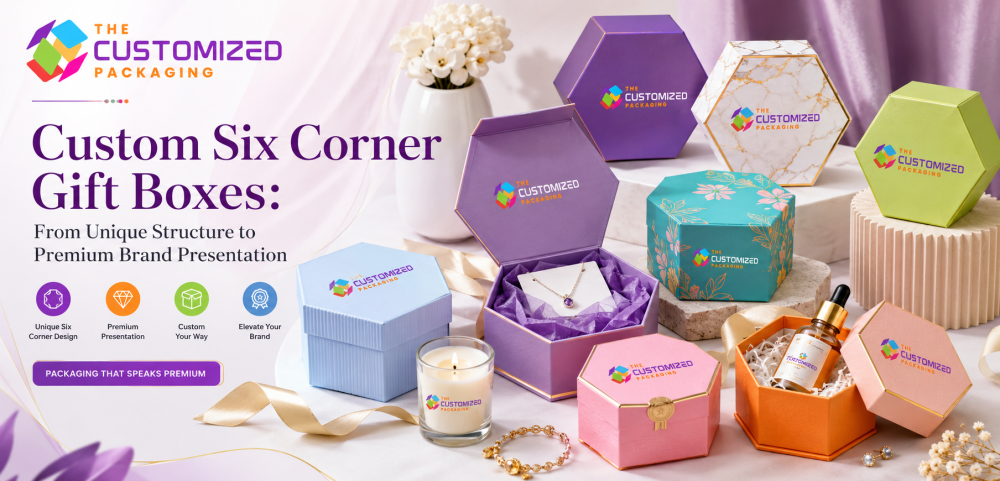
It is different from a hexagonal gift box. If you want a package with six equal outer sides, that is a hexagonal box. A regular six-corner box gets its name from the way its corners are formed.
For gifts, bakery products, cosmetics, confectionery, candles, apparel accessories and product collections, understanding that difference makes it much easier to choose the right structure.
What Makes a Regular Six-Corner Box Different?
The main advantage of a regular six-corner structure is the way the base forms.
Instead of relying on a simple tuck-end carton, the corner sections create defined sidewalls and a broad tray that can make products easier to load and present.
Depending on the design, the box may include:
-
Pre-glued corner sections
-
Attached hinged lid
-
Side-locking tabs
-
Folding tray base
-
Product window
-
Fitted insert or divider
-
Printed interior and exterior panels
The exact configuration should be chosen around the product rather than selecting a structure only because it has an unusual name.
Regular Six-Corner Box vs. Hexagonal Gift Box
If you are comparing the two, the difference is straightforward.
| Regular Six-Corner Box | Hexagonal Gift Box |
|---|---|
| Usually rectangular or tray-like when formed | Has six visible outer sides |
| Name refers to corner construction | Name refers to geometric shape |
| Commonly designed as a folding carton | Can be folding or rigid |
| Often includes an attached lid | May use a separate or attached lid |
| Can usually be stored relatively flat | Storage depends on structure |
| Useful when quick loading is important | Often chosen primarily for its shape |
Neither is inherently better.
The right option depends on whether you want the practical folding construction of a regular six corner box or the visual geometry of a true hexagonal package.
Start With the Product, Not the Box Dimensions
Before choosing the size, measure the complete item that will actually go inside.
That includes more than the product itself.
For example, a candle may also include a lid. A cosmetic set may contain several retail cartons. A confectionery product may sit inside a tray or liner.
Measure the finished packed arrangement:
length × width × height
Also consider the total packed weight.
Those two pieces of information help determine whether a lightweight paperboard structure is sufficient or whether the box needs a stronger material or additional interior support.
Choose the Size Around the Packed Arrangement
Oversizing a gift box can create unnecessary empty space and allow products to move.
Making it too tight can create different problems:
-
Difficult loading
-
Crushed products
-
Lid interference
-
Insert distortion
-
Poor presentation
If the box contains several products, arrange them before finalizing the outside dimensions.
Decide:
-
Which product should appear first?
-
Which items should sit together?
-
Will anything be stacked?
-
Does one product need more height?
-
Is an insert required?
A simple physical layout can reveal a better box size before the dieline is created.
Check the Packed Weight
The same six-corner structure cannot automatically handle every product.
A box for lightweight apparel accessories has very different requirements from packaging for a candle jar or several bottles.
The packed weight can affect:
-
Board choice
-
Base stability
-
Corner strength
-
Insert design
-
Carrying performance
-
Outer shipping protection
Always test the structure with the actual weight it is expected to carry.
A sample that looks perfect while empty may behave differently once the products are loaded.
Decide How the Box Should Arrive for Packing
Some custom six corner gift boxes can be supplied flat with key corner sections already glued.
Others may require more manual folding or locking.
Ask how the box will arrive and how many steps are required before it is ready to fill.
For businesses packing larger quantities, assembly time matters.
A structure that takes only a few extra seconds per box can add substantial labor when hundreds or thousands of units need to be prepared.
Test How Quickly the Box Sets Up
Do not judge assembly from one carefully folded sample.
Ask the people who will actually pack orders to assemble several boxes in a row.
Look for repeated problems such as:
-
Corners not opening properly
-
Tabs missing their slots
-
Base not sitting flat
-
Sidewalls leaning
-
Lid requiring adjustment
The ideal structure should become easy to form after a short learning period.
If staff regularly need to force the box into shape, the construction may need adjustment.
Make Sure the Base Sits Flat
Once assembled, place the empty box on a level surface.
The base should sit evenly rather than rocking noticeably from corner to corner.
Then load the actual products and check it again.
A properly developed base should remain stable under the intended load.
If the box begins twisting, bowing or lifting at the corners after loading, the board or structural design may need to be reconsidered.
Choose the Board for the Product
There is no single best material for every six-corner gift box.
Paperboard
Paperboard can work well for lightweight to medium-weight gifts, cosmetics, confectionery, accessories and retail products.
It provides a smooth printing surface and can usually be stored flat.
Kraft Board
Kraft can provide a natural paper appearance for handmade products, food gifts, wellness products, candles and other collections where the brown surface works with the brand.
Keep in mind that the kraft color becomes part of the artwork.
Corrugated Board
Corrugated material may be more appropriate when products are larger or heavier and need additional structural support.
The exact flute and construction should still be selected according to the packed product.
The material should follow the product requirement rather than being selected solely for appearance.
Hinged Lids Create a Wide Opening
Many regular six-corner boxes use an attached lid.
That can make the structure convenient for gift sets because customers can see a large portion of the contents as soon as the box opens.
The lid also creates useful space for:
-
Logo
-
Short message
-
Interior artwork
-
Product instructions
-
QR code
However, the lid still needs to align correctly with the base.
A poor corner setup can cause one side of the lid to sit higher than the other.
Always evaluate the box fully assembled.
Check Lid Clearance With the Products Inside
One of the most important tests is also one of the simplest.
Load the finished products.
Add the insert, tray, card or other components.
Then close the lid normally.
The contents should not press against the lid.
This is particularly important for:
-
Candle jars
-
Cosmetic bottles
-
Gift sets
-
Products with raised caps
-
Decorative products
-
Food items with toppings or extra height
If the box closes correctly when empty but lifts after loading, the internal height needs adjustment.
Side Locks Should Be Easy to Use
Some six-corner gift boxes use locking tabs or side closures.
They should feel secure without becoming difficult to assemble.
Watch for:
-
Tabs bending
Slots tearing
Closures popping back open
One side being harder to lock than the other
The correct closure depends on the product and packing process.
A highly secure lock is not useful if employees damage the box while trying to close it.
Inserts Can Turn One Open Tray Into an Organized Gift Set
A broad six-corner base can hold one product or several.
For multi-product packaging, an insert can create a more deliberate presentation.
Depending on the contents, the insert may:
-
Separate products
-
Hold bottles upright
-
Create compartments
-
Raise smaller items
-
Prevent movement
-
Keep labels facing upward
The insert should be designed around the finished internal dimensions of the assembled box.
Do not finalize it only from the external box dimensions.
Keep Heavy Products Supported Near the Base
Candles, jars and bottles should usually be supported from a stable lower area.
The insert should help distribute the weight rather than leaving a heavy product to move against the sidewalls.
For example, a candle gift set might use a fitted paperboard or corrugated support around the base of each jar.
A cosmetic set might use individual openings that keep bottles upright.
The exact insert depends on the product, but its first job is practical product control.
Make Products Easy to Remove
An insert can hold a product too tightly.
Customers should not need to shake the box or pry items out with their fingertips.
When a product sits deeply inside the insert, useful access features may include:
-
Finger notch
-
Side cutout
-
Ribbon lift
-
Raised platform
Secure fit and easy removal should be considered together.
Windows Should Be Positioned Around the Product
A window can be useful when the product itself helps sell the package.
That may apply to:
-
Confectionery
-
Candles
-
Decorative soaps
-
Cosmetics
-
Gift items
-
Handmade products
The window should be positioned after the final product location is known.
Otherwise, the product may sit too high, too low or off-center behind the opening.
The amount of material left around the window also matters because the surrounding panel still needs to fold and hold its shape.
Do Not Put a Large Window Too Close to a Corner Fold
Regular six-corner structures rely on several folds and corner sections.
Removing too much material close to those areas can make the panel less stable.
A better approach is to balance visibility with the structure.
The window should reveal the product without weakening the area that helps the box form properly.
Test the complete windowed sample rather than evaluating only the cutout shape.
Keep the Branding Simple Around the Structure
The lid is often the strongest place for the main logo.
Side panels can then carry secondary information such as:
-
Product name
-
Website
-
Collection name
-
Short message
-
Appropriate product details
Important artwork should stay clear of areas where multiple folds meet.
Do not design the box as if every structural panel were an advertising surface.
The product presentation should remain the main focus.
Review the Artwork on the Assembled Box
A flat dieline can make artwork placement look different from the final package.
Once the corners are folded, some graphics may move closer to:
-
Edges
-
Locks
-
Folds
-
Lid lines
-
Glue areas
Review a three-dimensional mockup or physical sample before final approval.
Check that the logo looks centered and important text remains easy to read.
Leave Space for Variable Labels When Needed
Businesses may need to add information after the boxes are printed.
That could include:
-
Recipient name
-
Product variation
-
Flavor
-
Order number
-
Event details
-
Customer message
Reserve a clean area if labels will regularly be added.
Otherwise, staff may end up covering the permanent artwork during fulfillment.
Use One Structure for Multiple Products When the Fit Allows It
A single six-corner box size may sometimes work for several products that have similar dimensions.
For example, one gift-box structure might support several seasonal collections while the printed card, insert or artwork changes.
This can simplify:
-
Storage
-
Packing
-
Inventory management
-
Staff training
But do not force products with very different dimensions or weights into the same box simply to reduce the number of packaging formats.
Shared packaging works only when the physical fit still makes sense.
Know When Another Box Style Is Better
A regular six-corner box is not automatically right for every gift.
Consider another structure when:
-
The product is too heavy for the selected construction
-
You specifically want a true hexagonal shape
-
A rigid keepsake box is required
-
The product needs substantial shipping protection
-
The packing process needs an even simpler structure
-
The product does not use the tray efficiently
Choosing the right box is more important than choosing an unusual one.
Protect the Gift Box During Shipping
A presentation box and a shipping box do different jobs.
If the six-corner gift box will travel through a parcel network, the presentation carton may need an additional corrugated mailer or outer shipping box.
This is especially important for:
-
Glass jars
-
Candles
-
Ceramics
-
Bottles
-
Fragile gift sets
The outer package helps protect the presentation box from labels, abrasion, corner damage and normal distribution handling.
Test the complete shipping configuration with the actual products.
Sample the Box Before a Larger Production Run
A physical sample allows you to check the complete package before committing to production.
Test:
-
Assembly
-
Corner formation
-
Base stability
-
Lid alignment
-
Product fit
-
Packed weight
-
Insert fit
-
Product removal
-
Window position
-
Artwork alignment
If the box will be packed in volume, assemble several samples consecutively instead of approving one carefully prepared unit.
Custom Six Corner Gift Box Checklist
Before approving your custom six corner gift boxes, confirm:
-
The requested structure is a regular six-corner box rather than a hexagonal box
-
Product dimensions are based on the finished packed item
-
Total packed weight is known
-
Board is suitable for the load
-
Corners form consistently
-
Base sits flat
-
Lid aligns correctly
-
Products do not interfere with the lid
-
Side locks or tabs are easy to use
-
Insert fits the assembled interior
-
Products remain correctly positioned
-
Products can be removed easily
-
Window aligns with the actual product
-
Artwork looks correct after folding
-
Variable labels have a planned location
-
Staff can assemble the box efficiently
-
Outer shipping protection is considered where required
These checks help ensure the box works just as well when packed as it does in a digital rendering.
Frequently Asked Questions About Custom Six Corner Gift Boxes
What is a regular six-corner gift box?
A regular six-corner gift box is a folding packaging structure that uses folded, locked or pre-glued corner sections to create a stable tray-style base. Many versions also include an attached hinged lid.
Is a six-corner box the same as a hexagonal box?
No. A hexagonal box has six visible outer sides. A regular six-corner box is named for its folding and corner construction and can have a rectangular or tray-style finished shape.
Can six-corner gift boxes be supplied flat?
Yes. Many folding versions can be supplied flat or partially pre-glued, depending on the structure and material.
What products work well in custom six corner gift boxes?
Depending on the dimensions, material and packed weight, they can be developed for gifts, cosmetics, confectionery, candles, bakery products, apparel accessories, stationery and promotional products.
Can six-corner gift boxes include inserts?
Yes. Inserts can divide multiple products, stabilize bottles or jars, raise smaller items and help keep products in the intended position.
Can a window be added to a six-corner box?
Yes. The window should be positioned around the final product location and kept far enough from important structural folds to maintain the integrity of the panel.
Are six-corner boxes suitable for heavy gifts?
It depends on the dimensions, material, corner construction and total packed weight. Heavier products may require stronger board, additional supports or another packaging structure.
Can custom six corner gift boxes be printed with a logo?
Yes. The lid and supporting panels can be printed with logos, brand colors, product information and other artwork according to the structure and material.
Do six-corner gift boxes need an outer shipping box?
For parcel delivery, an outer corrugated shipper may be appropriate depending on the product, presentation box and shipping conditions. Presentation packaging should not automatically be treated as courier protection.
Should I order a sample first?
Yes. A physical sample is the best way to check assembly, corner formation, product fit, lid clearance, insert position, window alignment and the finished presentation before production.
Choose the Structure Around the Product
The best custom six corner gift boxes are not selected simply because the structure is different from a standard carton.
They are selected because the folding base, wide opening and corner construction work well for the product being packed.
Start with the finished product dimensions and weight.
Then choose the board, lid, insert and optional window around the way the product needs to be loaded, presented and carried.
If your goal is a true six-sided geometric package, choose a hexagonal box instead. If you need the practical folding construction of a regular six-corner carton, develop the dimensions and features around the actual products.
The Customized Packaging develops custom six corner gift boxes around your product dimensions, packed weight, preferred lid, inserts, windows and branding. Share your product details and intended use to develop a structure that fits your packaging and presentation requirements.