
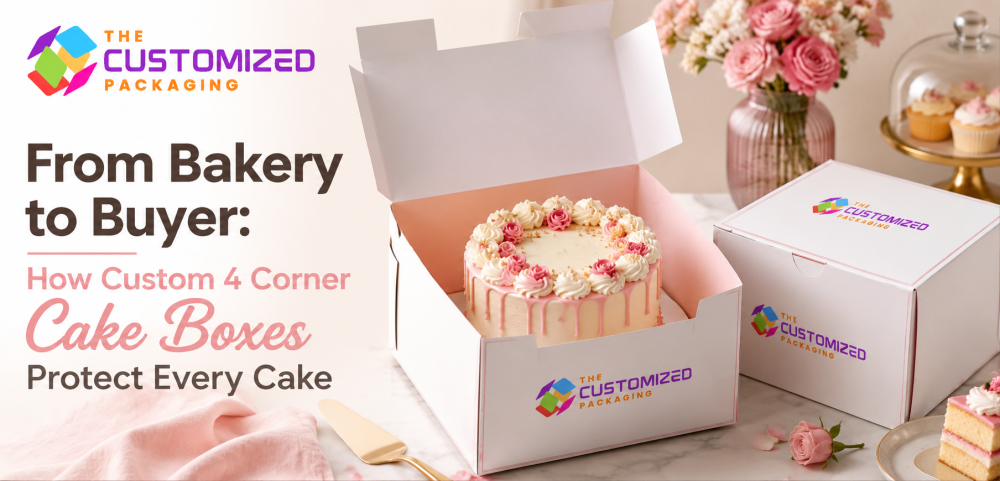
How to Pack and Transport Decorated Cakes in 4 Corner Cake Boxes
A correctly sized cake box still needs the right packing and handling process. Learn how bakery staff can load, store, carry and hand off decorated cakes in 4 corner cake boxes for customer pickup and local delivery.
 Published June 22, 2026
Updated September 07, 2026
12 min read
A decorated cake can fit correctly inside its box and still arrive damaged if it is loaded, carried or transported poorly.
From the decorating table, the cake may move into refrigeration, onto a pickup shelf, through the bakery counter, into a vehicle and finally into the customer's hands. Each stage creates different risks for the cake board, frosting, toppers and decorations.
That is why packaging performance does not end when the right box size has been chosen.
This article focuses on how bakeries can use 4 corner cake boxes during packing, storage, customer pickup and local delivery. If you are still determining the dimensions and structural requirements of the carton, start with 4 corner cake box sizing before developing the handling process.
Prepare the Box Before the Cake Is Ready
The finished cake should not be waiting while bakery staff search for a box or assemble one for the first time.
Prepare the carton on a clean, level surface before loading the product.
Check that:
-
The base sits flat
-
All four corners are fully formed
-
Locking tabs are engaged correctly
-
Side walls remain upright
-
The lid closes normally
-
Any window is secure
-
Any board support or insert is correctly positioned
If the structure requires several assembly steps, staff should already know the sequence before handling a finished decorated cake.
A repeatable setup process reduces unnecessary movement around the product.
Load the Cake on Its Final Board
The cake should normally enter the box on the board or drum that will remain underneath it during pickup and transport.
The cake board becomes part of the packed product.
This matters because the nominal cake diameter may be smaller than the actual space the box needs to accommodate.
For example, an eight-inch cake may sit on a larger board. Decorations may extend beyond the cake itself. A ribbon around the board can also slightly change the usable dimensions.
When specifying custom 4 corner cake boxes, measure the complete finished arrangement rather than only the baked cake.
Check Decoration Clearance Before Closing the Box
The finished cake may be wider and taller than the basic cake shape.
Check for:
-
Buttercream borders
-
Piped details
-
Fondant elements
-
Fruit
-
Chocolate pieces
-
Flowers
-
Acrylic toppers
-
Edible decorations
-
Side embellishments
None of these should be pressed against the carton walls or lid during normal handling.
A box that technically closes but touches a topper or frosting is still too tight for that finished product.
Pay particular attention to the highest decoration because even slight contact with the lid can damage the visual presentation.
Choose the Loading Method Around the Cake
There are two common ways a decorated cake may enter the box.
Top Loading
Top loading works when the cake can be lowered into the box without the sides touching the frosting or decorations.
Hold the cake board rather than the cake itself.
Keep it level while lowering it and avoid allowing the board edge to catch on the carton wall.
Front or Drop-Side Loading
Tall or heavily decorated cakes can be more difficult to lower through a deep opening.
A front-opening or drop-side structure allows the cake board to move into position while one side remains open.
The wall can then be raised and secured after the cake is positioned.
This can reduce contact with side decorations and can also make removal easier at the destination.
Control Movement at the Cake Board
A cake box should not rely on the cake itself to stop movement.
The cake board is the better point to control.
If the internal box area is much larger than the board, the cake can shift during turns, braking or carrying.
Start with correct sizing.
Where additional positioning is needed, custom packaging inserts or board supports can be designed around the cake board.
The support should not press against frosting or decorations.
Its job is to manage the board and help maintain position inside the carton.
Think About Protection at Every Stage
| Stage | Main Risk | What to Check |
|---|---|---|
| Packing | Frosting or decoration contacts the carton | Side and top clearance |
| Refrigeration | Box becomes crowded or distorted | Shelf space and storage conditions |
| Pickup shelf | Order is repeatedly moved | Visible order identification |
| Carrying | Cake tilts | Base support and level handling |
| Vehicle transport | Cake board slides | Flat surface and controlled movement |
| Local delivery | Repeated handling affects orientation | Stable loading and unloading |
| Customer handoff | Buyer carries it incorrectly | Clear transport instructions |
The carton helps create a controlled environment, but the complete process still depends on handling.
Close the Box Slowly
Once the cake is positioned, close the box gradually.
Watch the topper, top decoration and side clearance.
If the lid or closure resists, do not force it.
Resistance may indicate:
-
The cake is too tall
-
A topper is contacting the lid
-
A side decoration is touching the wall
-
The cake board is not fully positioned
-
An insert has shifted
-
A locking tab is folded incorrectly
Identify the cause before pressing the package closed.
For cakes where staff or customers need to inspect the decoration without reopening the box, window 4 corner cake boxes can provide visibility while keeping the cake enclosed.
Plan Refrigeration Around the Packed Cake
If the finished cake needs refrigerated storage, test the complete box in the bakery's actual refrigerator or cold room.
The package should sit level without being forced between other orders.
Avoid placing boxes so tightly together that the side walls, window or lid become distorted.
Order identification should remain visible without requiring staff to open or repeatedly move packages.
Useful external order information can include:
-
Customer name
-
Pickup time
-
Order number
Cake flavor
Cake size
Storage instructions should still follow the requirements of the actual cake rather than one generic rule for every bakery product.
Organize the Pickup Area
The journey to the customer often begins before the customer arrives.
A crowded pickup shelf can cause staff to move several cakes just to retrieve one order.
Where practical:
-
Keep boxes level
-
Avoid placing heavy items on top
-
Separate especially tall cakes
-
Keep order labels visible
-
Leave enough room to lift the package from underneath
-
Keep toppers or accessories with the correct order
A well-organized pickup area reduces unnecessary handling of finished cakes.
Carry the Cake From Underneath
For most decorated cakes, supporting the base is more important than holding the sides or lid.
Use both hands underneath larger packages and keep the carton level.
Avoid:
-
Carrying from one corner
-
Pressing side walls inward
-
Holding only the lid
-
Tilting the package sharply
-
Stacking another package on top
If the box includes a handle, its suitability should be tested with the actual packed weight.
A handle may be convenient for smaller products while a larger decorated cake is still better supported from underneath.
Put the Cake on a Flat Vehicle Surface
One of the most common transport problems is placing a cake on a sloped passenger seat.
The angle can encourage the cake board to move toward one side, particularly during braking and turns.
A flat vehicle floor or level cargo platform is usually a better location.
A clean non-slip mat beneath the box can help reduce movement between the carton and vehicle surface.
Keep the cake away from loose objects that could slide or fall against the package.
Customer Pickup and Local Delivery Need Different Planning
A customer collecting one cake from the bakery has a different handling pattern from a driver making several deliveries.
| Customer Pickup | Local Delivery |
|---|---|
| Usually one package | May involve several cakes |
| Short handoff process | Multiple loading and unloading steps |
| Customer controls the vehicle | Bakery controls more of the route |
| Simple instructions may be enough | Route and vehicle setup become important |
| Limited repeated handling | Repeated lifting may occur |
For local delivery, consider the route length, number of stops, available flat floor space, package height and how orders will be kept separate.
The packaging should work with the delivery process rather than being evaluated only at the bakery counter.
Be Careful With Tall and Delicate Cakes
Tall cakes create additional handling challenges because a small tilt at the base produces more movement near the top.
Raised toppers and delicate vertical decorations also need more clearance.
For tall cakes:
-
Keep the board level
-
Avoid unnecessary lifting
-
Check full decoration height
-
Protect removable toppers separately when practical
-
Make sure the walls remain upright
-
Avoid placing anything on top of the box
If a topper does not need to be installed before delivery, packaging it separately can sometimes reduce the required box height and lower the risk of damage.
Do Not Assume a Stronger Box Can Fix an Unstable Cake
Packaging cannot correct every product problem.
If the cake itself is structurally unstable, warm, leaning or poorly supported, a stronger carton cannot guarantee safe transport.
The cake, board, box and handling process need to work together.
Similarly, corrugated material or reinforced corners do not eliminate the need to keep the package level.
Packaging should support good bakery handling rather than replace it.
Use Printed Instructions Where They Help
Some transport information can be communicated directly on the packaging.
Useful customer-facing reminders might include:
-
Keep level
-
Support from underneath
-
Place on a flat surface
-
Follow the bakery's storage instructions
Keep the wording short.
Detailed care information can also be provided on a card or through a QR code.
Your custom printed 4 corner cake boxes content covers logo placement, order information, QR codes and artwork hierarchy in more detail.
The transport article should focus only on which instructions genuinely help during handoff.
Avoid Stacking Unless the Packaging Was Designed for It
A flat lid does not automatically mean another cake box can safely sit on top.
The upper package transfers weight into the carton below.
That can distort the lid, window or side walls and may eventually contact the cake.
Where several cakes are being delivered together, use individual floor positions or appropriate shelving whenever possible.
Only stack boxes when the full packaging arrangement has been designed and tested for that purpose.
Create a Simple Bakery Handoff Check
A short checklist can be especially useful for high-value, tall or heavily decorated cakes.
| Check | Confirm Before Handoff |
|---|---|
| Cake | Correct order and decoration |
| Cake board | Level and properly positioned |
| Box | Fully formed and closed |
| Clearance | Decorations do not touch the box |
| Label | Correct customer information |
| Toppers | Secure or packaged separately |
| Storage | Instructions provided where needed |
| Carrying | Customer understands level handling |
The purpose is not to create unnecessary paperwork.
It is simply to prevent small mistakes during busy pickup periods.
Test the Complete Journey With a Sample
A box should not be approved only because an empty sample looks good.
Test the full process using a representative finished cake or suitable equivalent weight and dimensions.
A practical test can include:
-
Assemble the box
-
Load the cake
-
Close the package
-
Place it in normal bakery storage
-
Move it to the pickup area
-
Carry it to a vehicle
-
Position it on a flat surface
-
Drive a realistic local route
-
Remove the box
-
Open it as the customer would
Check whether the board moved, walls bowed, decorations touched the carton or the closure became difficult.
Testing the complete process often reveals issues that are invisible in a flat dieline.
Common Cake Packing and Transport Mistakes
Using the Wrong Box at the Last Minute
The correct packaging should already be selected before the cake reaches the final decorating stage.
Measuring Only the Cake Diameter
The cake board and finished decorations also affect the required space.
Allowing the Lid to Touch a Topper
The finished decoration determines the required internal height.
Using Loose Filler to Correct an Oversized Box
Correct sizing or controlled board support is a better solution.
Carrying the Box From the Top
Support larger cakes from underneath.
Putting the Cake on a Sloped Car Seat
Use a flat, stable vehicle surface where possible.
Giving the Customer No Instructions
A few clear handling reminders can prevent avoidable mistakes after handoff.
Frequently Asked Questions
How should I pack a decorated cake in a 4 corner cake box?
Place the finished cake on its final cake board, confirm adequate side and top clearance, load it while keeping the board level and close the box without allowing the carton to contact decorations.
How do I stop a cake from sliding inside the box?
Start with a box sized appropriately for the cake board. Where additional control is needed, a fitted board support or insert can help limit movement.
Is it safe to transport a cake on a car seat?
A flat and level vehicle surface is generally preferable to a sloped seat because it provides a more stable platform for the cake box.
How should customers carry a cake box?
Larger decorated cakes should generally be kept level and supported from underneath rather than carried by the lid or one side.
Can 4 corner cake boxes be used for local delivery?
Yes, when the box size, board strength, closure and cake-board support suit the finished cake and the packed system has been tested for the intended handling conditions.
Should I stack cake boxes during transport?
Avoid stacking decorated cakes unless the packaging system has specifically been designed and tested for stacked loads.
Do window cake boxes protect cakes during transport?
A window can allow visibility while the cake remains enclosed, but the complete carton still needs adequate strength, closure and board stability for the intended transport conditions.
Keep the Cake Protected From Bakery to Buyer
A good cake box is only one part of a reliable delivery process.
Prepare the carton before the cake is ready. Load the finished cake on its board, maintain clearance around decorations, control movement at the base, carry the package level and place it on a stable vehicle surface.
Then make the customer handoff equally clear.
When the cake, board, packaging and handling process are planned together, bakeries have a much better chance of keeping decorated products in the condition intended from the packing table to the final destination.
If your existing box does not provide enough clearance, board control or loading access, The Customized Packaging can develop bakery packaging boxes around the dimensions and handling requirements of your finished products.


