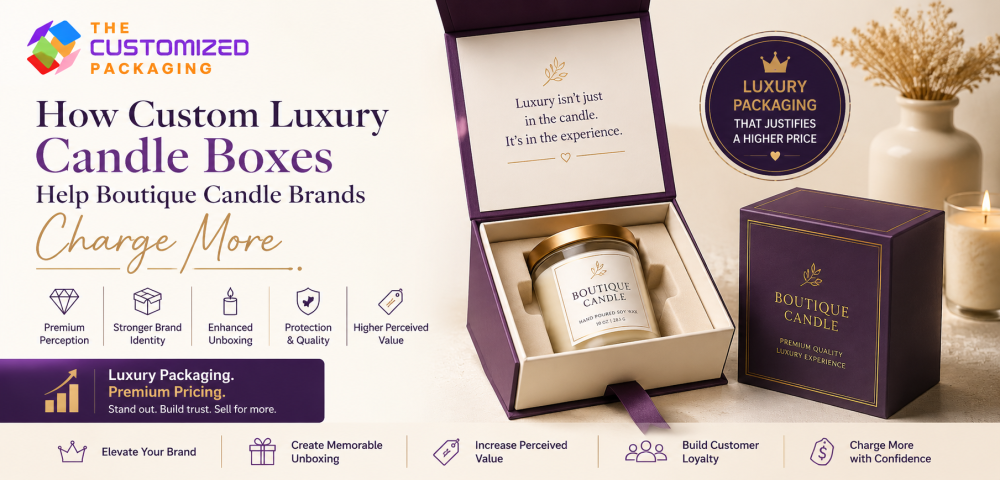
How Custom Luxury Candle Boxes Help Boutique Candle Brands Charge More
Luxury packaging cannot justify a higher candle price by itself. Learn how to align the box, vessel, fragrance story and customer experience with a sustainable premium-pricing strategy.
 Published June 15, 2026
Updated August 05, 2026
13 min read
A higher price should represent more value, not simply more packaging.
A boutique candle may cost more because it uses a distinctive fragrance, carefully selected wax, a high-quality wick, a decorative vessel, smaller production runs or a more demanding manufacturing process. Packaging can help customers see and understand those differences before they light the candle.
Custom luxury candle boxes can therefore support premium positioning, but they cannot create it alone. A thick rigid box around an ordinary product may increase cost without increasing the customer’s willingness to pay.
The better strategy is to align the candle, vessel, story, box and buying occasion so the complete offer feels worth its price.
What Does Premium Pricing Mean for a Candle Brand?
Premium pricing means charging more than basic alternatives because the offer provides meaningful differences that a target customer recognizes and values.
Those differences may include:
-
A distinctive fragrance composition
-
Higher-quality or decorative vessels
-
Specialized wax or wick choices
-
Small-batch production
-
Hand-finishing
-
Gift-ready presentation
-
Limited availability
-
Personalized service
-
Strong design and brand identity
-
Reliable product performance
Packaging makes some of these qualities easier to communicate. It can explain the fragrance, frame the vessel, organize a gift set and present the product consistently.
It does not prove that the candle burns well, performs safely or uses better ingredients. The physical product must support the position suggested by the box.
Packaging Is a Value Signal, Not Proof of Quality
Customers often form expectations before using a product. Structure, printing, color, product fit and material texture can influence those expectations.
Research across consumer-product categories indicates that packaging design elements can affect perceived value and purchase intention. However, those findings do not establish that a particular candle box will produce a specific price premium.
A substantial package may suggest care and quality, but the experience quickly breaks down when:
-
The vessel moves inside the box
-
The lid fits poorly
-
The print is inconsistent
-
The candle arrives damaged
-
The fragrance description is unclear
-
The product does not perform as expected
-
The package contains excessive empty space
Premium presentation works best when it confirms a level of quality that already exists.
Build the Price Architecture Before Designing the Box
Boutique candle brands often sell several levels of product. Packaging should help customers understand the differences between them.
| Product tier | Possible offer | Suitable packaging direction |
|---|---|---|
| Entry collection | Standard vessel and core fragrances | Refined folding carton or printed sleeve |
| Signature collection | Distinctive jar and developed fragrance story | Reinforced carton or two-piece box |
| Premium collection | Heavy glass or ceramic vessel | Rigid lid-and-base, drawer or magnetic structure |
| Gift collection | Candle with accessories or additional products | Compartmented presentation box |
| Limited edition | Special fragrance, artwork or collaboration | Existing premium structure with exclusive sleeve or finish |
| Personalized order | Wedding, corporate or event candle | Standard structure with variable card, label or band |
This creates a visible price ladder.
Customers can understand why a signature candle costs more than an everyday product and why a complete gift set carries a different price from a single jar.
Using the same elaborate structure for every product removes this hierarchy and may make the entry collection unnecessarily expensive.
Work Backward from the Required Margin
A box should be evaluated as part of the full product cost.
A basic contribution calculation considers:
Selling price – candle cost – packaging – fulfillment – selling fees – shipping support = contribution margin
Packaging cost includes more than the printed box. It may also include:
-
Insert
-
Dust cover
-
Care card
-
Tissue
-
Ribbon
-
Assembly labor
-
Storage
-
Protective shipper
-
Damaged or obsolete inventory
A package that adds $4 to the product cost does not automatically justify raising the retail price by $4. The customer must value the improved offer enough to accept the new price, while the business must still protect its intended margin.
Willingness to pay should be measured rather than assumed. Pricing research distinguishes between stated preferences what customers say they would pay and revealed preferences shown through real purchasing behavior.
Use the Box to Explain Why the Candle Is Different
Customers cannot always identify a premium candle by looking through the glass.
The packaging can make relevant differences easier to understand through:
-
Fragrance family and scent notes
-
Candle and vessel size
-
Wax information
-
Wick details
-
Production approach
-
Collection inspiration
-
Candle-care guidance
-
Refill or vessel-reuse information
-
Verified sourcing or material details
The information should remain concise and specific.
A sentence explaining that a fragrance combines cedar, leather and amber is more useful than repeatedly calling it exclusive or luxurious. A statement about small-batch pouring should only appear when it accurately describes the production process.
Packaging supports price confidence when it replaces vague prestige language with information the customer can understand.
Make the Vessel and Box Feel Like One Product
A premium jar placed loosely inside a generic carton looks like two separate purchasing decisions.
The box should be developed around the completed vessel, including its lid, label and filled weight.
Check:
-
Maximum jar diameter or width
-
Complete height
-
Filled weight
-
Lid overhang
-
Label position
-
Decorative surfaces
-
Insert thickness
-
Removal clearance
The customer should see the front of the vessel in the intended direction when the package opens.
A fitted paperboard platform, corrugated support, molded pulp cavity or wrapped insert may keep the jar centered. The chosen support should reflect the product’s weight and fragility rather than the desired price alone.
Protecting an expensive vessel also protects the brand’s margin by reducing preventable damage, replacements and refunds.
Choose the Structure According to the Added Value
Folding Cartons
A precisely sized folding carton can support a premium retail candle without excessive cost or storage demand. Good board selection, accurate printing and one controlled finish may be enough.
This is often appropriate for core fragrances and higher-volume collections.
Two-Piece Packaging
A separate lid and base create a gift-like reveal. The format works well for signature jars, wedding candles and premium retail collections.
The lid depth, insert and removal method should be tested with the actual vessel.
Drawer Boxes
A sliding tray creates a gradual opening and can organize a candle with matches, a care card or a small accessory.
The loaded tray should move smoothly without becoming loose or difficult to open.
Magnetic Closures
A hinged magnetic structure offers a large interior surface for fragrance storytelling and gifting messages. It is better suited to premium sets and special releases than every standard candle.
Rigid Presentation Boxes
Rigid candle boxes provide firm walls and a substantial feel. They can be appropriate for decorative vessels and high-value gifts, but their cost, storage volume and shipping protection should be considered before selection.
The most expensive structure is not always the most profitable one.
Gift Convenience Can Create Genuine Added Value
Gift-ready presentation offers a practical benefit. It can reduce the purchaser’s need to find separate wrapping, tissue, bags or gift containers.
Candle gift packaging may include:
-
A presentation box
-
Fitted product support
-
Candle-care card
-
Fragrance information
-
Gift-message area
-
Matches or wick trimmer
-
Coordinated sleeve or ribbon
-
Personalization
This additional convenience can support a separate gift price when the complete offer has been intentionally designed.
The price difference should reflect what the customer receives. A ribbon added to a standard carton does not necessarily create a premium gift tier.
Gift products should also be compared with other ready-to-present options in the target market—not only with the brand’s unboxed candle.
Boutique Brands Should Avoid Competing Only on Jar Size
When candles are described only by ounces, wax type and burn time, customers can compare them almost like commodities.
A distinctive presentation can shift attention toward:
-
Fragrance concept
-
Vessel design
-
Collection identity
-
Gifting suitability
-
Craft process
-
Interior styling
-
Brand story
-
Refill or reuse model
This does not eliminate price comparison. It gives the customer more meaningful attributes to compare.
The brand must still communicate those attributes clearly. Unusual packaging with no clear fragrance or product information can create confusion instead of differentiation.
Create Premium Tiers Without Redesigning Everything
Boutique businesses often have limited packaging storage and smaller order quantities. Creating a completely different box for every fragrance can tie up cash and leave unused inventory.
A modular system may use:
-
One core box size
-
One tested insert
-
A permanent logo treatment
-
Fragrance-specific sleeves
-
Seasonal labels
-
Limited-edition cards
-
Interchangeable dust covers
-
Personalized belly bands
This lets the brand create standard, gift and limited-edition versions without manufacturing a separate rigid structure for every launch.
The core packaging should remain neutral enough to support several collections but specific enough to fit the candle properly.
Limited Editions Need a Real Point of Difference
Calling a candle limited edition does not make it more valuable by itself.
A special release may offer:
-
An exclusive fragrance
-
Artist collaboration
-
Numbered production
-
Different vessel
-
Seasonal formulation
-
Personalized artwork
-
Event-specific presentation
-
Coordinated accessory
The packaging should make that difference visible.
A numbered card, changed sleeve, alternate foil or special interior may be sufficient when the main structure remains the same. This can protect margins and reduce excess seasonal stock.
Artificial urgency and unsupported scarcity statements should be avoided. The quantity or availability claim should reflect the real offer.
Premium Printing Should Improve Recognition
Custom printed candle boxes should make the brand and fragrance easier to identify, not merely add decoration.
Useful print decisions include:
-
Consistent logo placement
-
Clear fragrance hierarchy
-
Repeatable color system
-
Readable scent notes
-
Controlled typography
-
Interior message
-
Product code
-
Barcode area
-
Care-information placement
Finishes such as foil, embossing, debossing and spot gloss can establish hierarchy. One carefully selected finish often produces a more confident result than several competing effects.
Dark matte surfaces, metallic wraps and soft-touch coatings should be physically tested for rubbing, fingerprints and lid friction before production.
Do Not Let Packaging Cost Consume the Premium
Premium packaging can increase the selling price while still reducing profitability when:
-
The minimum order is too large
-
Too many artwork versions are produced
-
Assembly takes too long
-
Boxes occupy excessive storage space
-
Dimensional shipping cost increases
-
Seasonal packaging becomes obsolete
-
Damage is not actually reduced
-
Customers do not accept the new price
Brands should calculate the margin for each packaging tier separately.
For example, the everyday carton, premium rigid box and complete gift set should not all be evaluated using one average packaging cost.
A structure is financially useful when it contributes to a profitable offer—not merely when it looks impressive.
Test the Price and Package Together
Do not redesign the box and immediately increase the price across every channel.
A controlled test can compare:
-
Existing packaging at the current price
-
Improved packaging at the current price
-
Improved packaging at a moderately higher price
-
Gift-ready packaging as a separate SKU
Keep other variables as consistent as practical.
Useful indicators include:
-
Conversion rate
-
Units sold
-
Gross or contribution margin
-
Gift-order share
-
Retailer feedback
-
Damage and return rate
-
Repeat purchase
-
Customer comments
-
Discount dependence
-
Sales by packaging tier
A higher price with fewer sales may still improve profit, while a beautiful package that requires frequent discounts may not be supporting its intended position.
Price testing should be gradual and based on actual customer behavior.
Use Retail Feedback Before Expanding Distribution
Boutiques and specialty retailers evaluate more than the appearance of the box.
They may consider:
-
Shelf dimensions
-
Product facings
-
Barcode placement
Fragrance identification
Storage efficiency
Case quantities
Damage protection
Wholesale margin
Recommended retail price
Collection consistency
A package can support retail placement when it makes the product easy to display and understand.
However, a heavy or oversized box can reduce the number of units a store can stock. The presentation must work for the retailer as well as the customer.
Communicate Environmental Features Precisely
Natural kraft paper, recycled-content board and molded pulp can support selected brand directions, but the finished package should not automatically be described as sustainable or eco-friendly.
Laminates, coatings, foil, adhesives, windows, ribbons and inserts can change the material system.
FTC guidance recommends using specific, supportable environmental claims rather than broad unqualified statements.
Better wording may identify:
-
Verified recycled-content percentage
-
Certified paper used for the production
-
Removal of a plastic component
-
Paperboard replacing foam
-
Reduced external dimensions
-
Separation instructions
-
Refill or vessel-return program
Environmental messaging should not be used only to make a higher price appear justified. It should describe an actual feature of the candle or package.
Prepare a Commercial Packaging Brief
Before requesting pricing for wholesale luxury candle boxes, prepare:
-
Current retail price
-
Intended premium or gift price
-
Candle dimensions and filled weight
-
Vessel material
-
Product tier
-
Retail, ecommerce or gifting use
-
Preferred structure
-
Insert requirements
-
Artwork variations
-
Finishes
-
Assembly needs
-
Quantity for each version
-
Delivery location
-
Required date
The supplier can quote the packaging, but the candle brand must determine whether the complete product economics support the investment.
Most custom styles begin at 100 units, although rigid structures, specialized materials and multiple designs may have different production requirements.
Why Choose The Customized Packaging?
The Customized Packaging develops boutique candle packaging around the product, collection structure, vessel and intended sales channel.
Available options include folding cartons, two-piece packaging, magnetic closures, drawer boxes, rigid presentation structures, printed sleeves, fitted inserts and divided gift sets.
Projects can be created for core fragrance ranges, signature jars, seasonal launches, wedding candles, corporate gifts and limited editions.
Our team can help compare structural options, materials, artwork treatments and quantities. The objective is to develop packaging that supports the intended product tier without adding cost or complexity that the brand cannot use profitably.
Frequently Asked Questions
Can luxury packaging make customers pay more for a candle?
It can support a higher price when the candle, vessel, fragrance, story and presentation provide meaningful added value. Packaging alone cannot guarantee willingness to pay.
How much should a candle brand spend on packaging?
There is no universal percentage. The acceptable cost depends on the selling price, candle cost, fulfillment expenses, channel fees, shipping support and required contribution margin.
Do boutique candle brands need rigid boxes?
No. A precisely printed folding carton may be appropriate for core products. Rigid structures are better reserved for products and gift tiers that justify their cost and storage demands.
How can packaging create a premium product tier?
Use a clearly different structure, vessel presentation, gift component, fragrance story or level of personalization. The customer should receive a meaningful difference—not only a more decorated box.
Should every fragrance have different packaging?
Not necessarily. One tested structure can support several scents through color, sleeves, labels, dust covers or cards. This can reduce setup costs and unused inventory.
How should a brand test a higher price?
Introduce the package and price gradually, compare similar customer groups or sales periods and track conversion, margin, gifting demand, damage, returns and discount dependence.
Charge for the Value Customers Can See and Experience
Premium pricing should not begin with the question, “How expensive can the box look?”
It should begin with the candle, customer and buying occasion.
The product must perform well. The fragrance needs a clear identity, the vessel should feel appropriate and the packaging should make those qualities easier to recognize. The price must then preserve a healthy margin while remaining acceptable to the intended customer.
When those decisions work together, premium candle packaging can help a boutique brand present a price worth paying rather than simply asking customers to pay more.