



| Specification | Details |
|---|---|
| Product | Custom Corrugated Boxes |
| Primary Material | Fluted corrugated board |
| Construction | Single-wall, selected double-wall and specialty grades |
| Liners | Natural kraft, white and approved alternatives |
| Flute | Project-dependent F, E, B, C or suitable combinations |
| Board Grade | Confirmed for packed weight and handling requirements |
| Strength Rating | Only as supported by applicable material and test documentation |
| Structures | Mailer, shipping case, display and selected die-cut styles |
| Dimensions | Custom internal dimensions |
| Product Weight | Required for structural selection |
| Closure | Compatible interlocking, tuck, glue or sealing methods |
| Assembly | Flat-packed or approved structural supply format |
| Inserts | Corrugated partitions, platforms and supports |
| Printing | Compatible digital, flexographic or selected other methods |
| Print Areas | Outer panels, selected inner panels and inserts |
| Artwork | Logos, instructions and approved brand graphics |
| Finishing | Compatible coatings and surface treatments |
| Moisture Performance | Not presumed waterproof; validation required for claims |
| Environmental Data | Based on actual materials and documentation |
| Quantity | Minimum determined by approved configuration |
| Production and Delivery | Confirmed after technical review and approval |
| Quote | Based on dimensions, board, structure, printing and destination |
Custom Corrugated Boxes for Shipping, Retail, and Product Packaging
Custom Corrugated Boxes are made from fluted paper-based board that can be converted into shipping cartons, ecommerce mailers, display trays, and other packaging structures. The fluted layer separates the liner sheets and contributes to the material's rigidity and structural properties.
The appropriate construction depends on the box's purpose. A retail display may prioritize printed presentation and product access, while a parcel shipper requires suitable closure security and protection during handling. A heavy product may need a different board grade and wall configuration from a lightweight accessory.
This page explains corrugated materials and general structural choices. Product-specific pages provide additional detail about individual mailer, snap-lock, display, and shipping formats.
How Corrugated Board Is Constructed
A typical single-wall corrugated board has an inner liner, a fluted medium, and an outer liner. The combined structure can be cut, scored, folded, and assembled into different box formats.
Material behavior depends on the liner composition, paper weight, flute profile, bonding, and board orientation. The finished box also depends on dimensions, load, stacking conditions, and closure design.
Corrugated board is not a uniform material. Before ordering a particular structure, the required board grade should be reviewed against the actual packed product.
Single-Wall, Double-Wall, and Specialty Corrugated Board
Single-wall board has one fluted layer between two liners. Double-wall board combines two fluted layers with additional liner material. The extra material may provide different structural characteristics, but also affects box weight, fold geometry, and cost.
For smaller branded retail cartons, thinner microflute grades may provide a relatively compact presentation. Larger shippers or heavier packages may require a different flute or wall configuration.
Corrugated Board Construction Comparison
| Construction | Typical Characteristics | Selection Consideration |
|---|---|---|
| Microflute | Thin corrugated construction | Compact folding and detailed printing requirements |
| Single-wall | One fluted layer between liners | Match board grade to filled weight and handling |
| Double-wall | Two fluted layers with additional liner | Thickness, load requirements, and fold compatibility |
| Kraft-lined | Natural brown outer paper surface | Print contrast and brand appearance |
| White-lined | Bright printable outer surface | Detailed graphics and retail presentation |
| Selected recycled-content | Specified recovered fiber content | Verify actual percentage and performance |
No edge crush test, burst test, compression rating, or stacking limit should be assigned without verified results for the actual board and box design.
Corrugated Flute Profiles and Selection
Flute profiles influence board thickness, stiffness, bending behavior, and printing characteristics. Thin grades may be appropriate for compact cartons, while thicker grades can be considered for larger packages.
F-flute and other specialty grades may be relevant to selected applications, but not all profiles are available for every structure. Availability and manufacturing feasibility must be confirmed before production.
Flute Comparison for Packaging Planning
| Flute | Potential Application | Important Limitation |
|---|---|---|
| F-flute | Selected microflute retail cartons | Material availability and structural fit |
| E-flute | Compact branded cartons and mailers | Board grade and packed weight |
| B-flute | Selected ecommerce and shipping cases | Box dimensions and handling requirements |
| C-flute | Selected larger protective shipping cases | Fold geometry and board strength |
| Combined flutes | Specialized heavier applications | Tooling and manufacturing feasibility |
A flute designation alone does not establish a particular weight capacity or shipping rating.
Corrugated Box Styles and Structural Boundaries
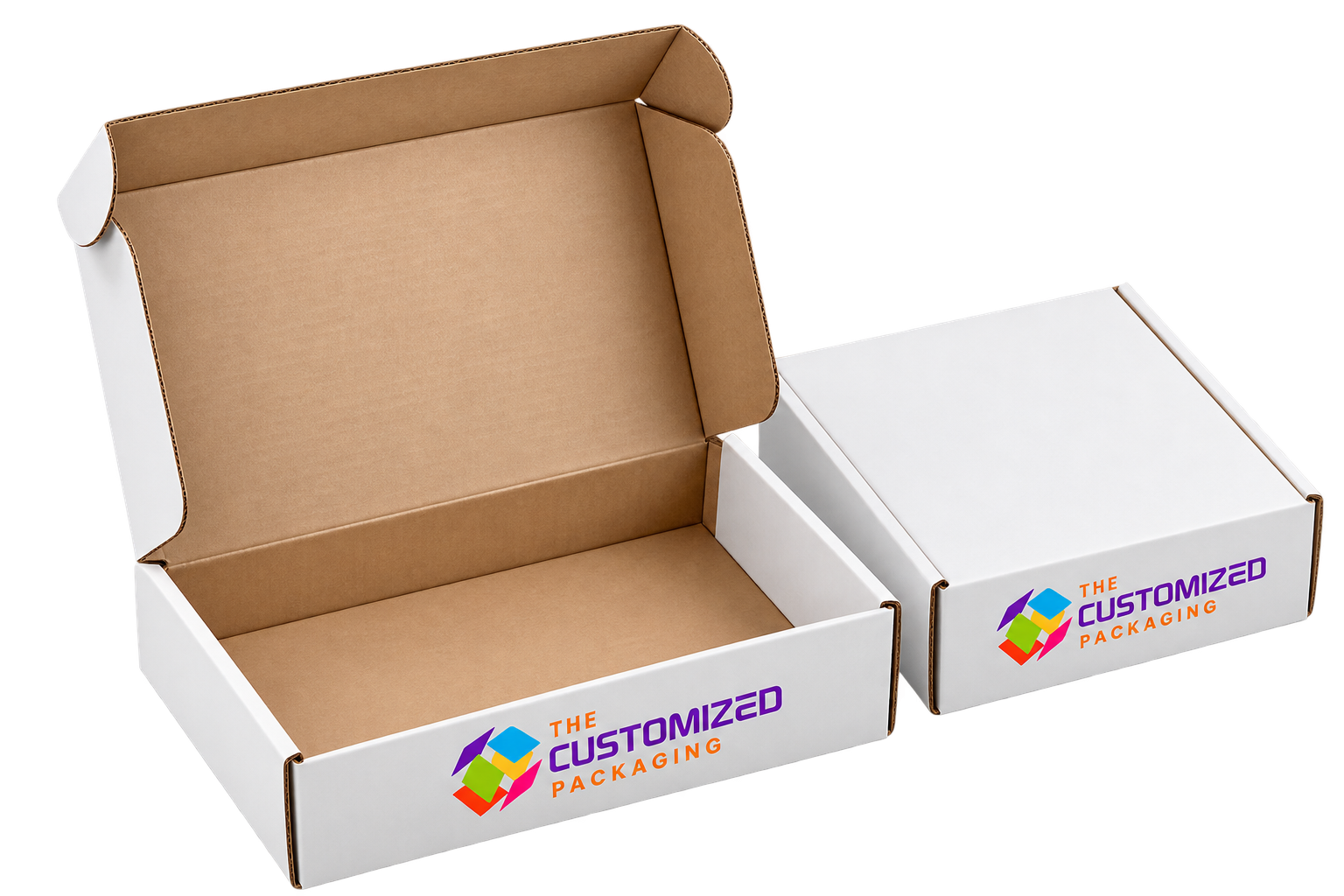
Corrugated board can be converted into regular shipping cases, die-cut mailers, interlocking-bottom cartons, display trays, and custom-shaped packages. Those styles have different openings, assembly requirements, and product applications.
Mailer Boxes
Mailer constructions commonly use an attached lid and folding panels to form a compact package. For a dedicated mailer structure, see our custom kraft mailer boxes. A mailer is one corrugated box style, not a name for every corrugated carton.
Snap-Lock Boxes
Snap-lock bottoms use manually folded interlocking panels. Our custom corrugated snap lock boxes page explains that closure, including assembly, material options, and base-support considerations.
Shipping and Retail Display Structures
Shipping cartons prioritize enclosure and handling performance, while display structures emphasize product access and merchandising. Their board grades, cutting patterns, and internal supports may differ.
Custom Corrugated Box Sizes and Measurements
Correct dimensions begin with the actual product or packed arrangement. The usable inside measurements are particularly important when cushioning, dividers, or accessories occupy some of the carton space.
Measurements Required for Your Corrugated Box
Begin the structural specification with the following measurements:
- Internal length: Space required along the product's longest packed dimension.
- Internal width: Clearance required across the product or packed arrangement.
- Internal height: Space needed for the complete product and selected protective components.
- Insert allowance: Additional space occupied by partitions, platforms, cushioning, or supports.
- Packed weight: Total load including products, accessories, and internal packaging.
For regular shipping cases, orientation and stacking may influence the box dimensions. For fitted mailers, closure folds and side-panel depth affect usable internal capacity.
Fragile or heavy products may need more support than a basic empty-box mockup suggests. A packed sample helps establish the practical fit.
Corrugated Inserts and Product Protection
Inserts help organize several items, reduce unwanted movement, and separate products from external box walls. Their construction should reflect the contents and how the package will be handled.
Possible Insert and Support Options
- Corrugated partitions: Separate products or containers within one box.
- Die-cut platforms: Position selected merchandise at a specific height.
- Folded corner supports: Create separation around vulnerable product edges.
- Fitted dividers: Organize kits containing different components.
- Suitable cushioning: Provide additional separation for fragile contents when required.
The insert and outer carton must be assessed as one system. Corrugated construction does not guarantee damage-free shipping, even when inserts are fitted.
Custom Printed Corrugated Boxes with Logo
Custom printed corrugated boxes can feature logos, product names, shipping information, handling instructions, barcodes, QR codes, and promotional artwork. Printing should be selected around liner type, coverage, structure, and quantity.
Kraft liners may complement simple typography and restrained graphics. White liners provide a brighter surface for detailed artwork and full-color brand presentation.
Depending on the production method and selected board, digital, flexographic, or other suitable printing processes may be considered. Artwork must allow for folding panels, glued areas, closure tabs, and shipping labels.
Retail Display Boxes vs Ecommerce Shipping Boxes
A corrugated display tray is developed around shelf placement, visibility, access, and product arrangement. An ecommerce shipper must also meet the requirements of closing securely and handling the packed contents during distribution.
A display structure may be shipped inside another protective case, but should not automatically be treated as its own parcel shipper.
For a dedicated shipment-oriented structure, compare our custom corrugated shipping boxes. That product focuses more directly on outer shipping and delivery packaging. The existing double-g spelling is part of its live URL.
Moisture Exposure, Handling, and Strength Limitations
Corrugated material can be affected by water, prolonged humidity, unsuitable storage, and other environmental conditions. A standard untested corrugated carton should not be described as waterproof.
Stacking, impacts, vibration, and repeated handling may also affect performance. The box structure, board grade, closure, and protective components should be reviewed against the expected distribution environment.
Numerical strength ratings, crush-proof claims, and guaranteed transit outcomes require supporting product-specific testing or documentation.
Recycled Content and Environmental Claims
Some corrugated constructions incorporate recovered paper fibers and may be accepted through suitable local recycling systems. However, environmental performance depends on the complete box and the relevant collection conditions.
Coatings, adhesives, films, labels, and mixed-material components can influence recyclability and disposal. A corrugated box should not automatically be labeled biodegradable, compostable, or environmentally certified without supporting evidence.
Brands should consider right-sized designs, material efficiency, actual protection needs, and documented material specifications rather than relying on broad sustainability promises.
Wholesale Corrugated Box Pricing and Ordering
Wholesale corrugated box pricing is influenced by dimensions, flute, liner, wall construction, structure, tooling, printing coverage, inserts, order quantity, and shipping destination.
A simple shipping case may have a different manufacturing cost from a detailed die-cut mailer or retail display. Specialty board combinations, print methods, and low-volume configurations require individual production review.
Information Needed for a Corrugated Box Quote
Prepare these details before requesting pricing:
- Preferred box format and intended use.
- Internal length, width, and height.
- Complete packed product weight.
- Board or flute preference, if known.
- Printing artwork and required coverage.
- Insert or divider requirements.
- Order quantity and delivery destination.
Our Custom Box Packaging Cost Calculator provides preliminary budget guidance. Final pricing and production timing are confirmed after the structure and manufacturing requirements have been reviewed.
Request a custom corrugated box quotation using your preferred carton structure, internal dimensions, product weight, board requirements, and print design. These details help determine which fluted construction and production process should be evaluated.
Corrugated board contains a fluted paper layer and one or more liners, while ordinary folding paperboard is generally made without that fluted construction. Their structural properties, thickness, printing options, and applications differ. The correct choice depends on the product and intended use.
Flute selection depends on box dimensions, packed weight, printing requirements, closure, and handling. E-, B-, C-, and selected micro flute or combined constructions may be considered. A flute designation alone does not establish a specific load rating.
Yes, different corrugated structures can be developed for shipping, ecommerce mailers, and retail displays. Each has different structural and usability requirements, and a display carton should not automatically be treated as an outer shipping case.
No universal claim should be made for every finished corrugated box. Recyclability depends on the selected board, coatings, adhesives, labels, and local collection systems. Recycled content, biodegradability, and certification claims require suitable documentation.
Provide your internal dimensions, packed product weight, preferred style, material requirements, artwork, quantity, and USA delivery ZIP code. Board grade, printing, tooling, and delivery can materially change the final quotation.
Related Products


Order Custom Corrugated Boxes from The Customized Packaging
We manufacture Custom Corrugated Boxes for businesses that need reliable product protection, accurate printing, and professional packaging for retail, ecommerce, storage, or shipping. Each box can be customized by size, material, structure, printing, coatings, finishes, inserts, and order quantity.
Share your artwork and quantity targets for Custom Corrugated Boxes and we will recommend the most cost-effective structure for your timeline. or speak with a packaging expert.