

| Specification | Details |
|---|---|
| Product | Custom Cereal Boxes |
| Packaging Purpose | Printed secondary retail food cartons |
| Primary Contents | Suitable sealed cereal bags, pouches and individual packs |
| Applications | Breakfast cereals, granola, clusters and related packaged assortments |
| Materials | Suitable folding paperboard and kraft grades |
| Board Grade | Selected for finished pack dimensions and weight |
| Structure | Folding carton or approved multipack configuration |
| Dimensions | Based on the finished sealed inner package |
| Bag Clearance | Allowance for filled bag shape and seals |
| Closure | Selected tuck or approved structural closure |
| Printing | Compatible digital or offset production |
| Artwork | Brand-supplied graphics and product information |
| Information Panels | Reserved space for applicable Nutrition Facts and other labeling |
| Window | Optional, subject to compatibility review |
| Dispensing Feature | Only where structurally and functionally approved |
| Inserts | Selected dividers or product supports |
| Primary Barrier | Provided by the suitable sealed inner packaging |
| Food Contact | Any direct-contact component requires separate verification |
| Artwork Proofing | Digital proof and suitable production checks |
| Quantity | Project-specific confirmed manufacturing minimum |
| Production and Delivery | Confirmed after requirements and artwork approval |
| Quotation | Based on materials, dimensions, printing, quantity and destination |
Custom Cereal Boxes for Branded Retail Packaging
Custom Cereal Boxes are printed secondary cartons used to present breakfast cereals, granola, cereal clusters, and related products sold inside sealed primary bags or other suitable food containers. The outer carton gives the brand a recognizable shape and printable surfaces for product artwork, identification, and approved labeling.
A suitable cereal carton is designed around the filled inner package rather than the cereal's nominal weight or an empty bag. Light cereal flakes may occupy more volume than a denser granola mix of similar weight, so the actual packed shape matters.
The carton alone does not establish product freshness, food-contact suitability, moisture protection, or shelf life. The primary food package and complete validated packaging system remain responsible for those functions.
Cereal Cartons for Different Sealed Product Formats
Cereal products are packed in different ways. Some use a large sealed bag inside an upright carton, while others use smaller pouches arranged within a multipack or sampler box.
Brands should provide the finished inner-package dimensions after normal filling and sealing. This helps determine the appropriate carton depth, closure design, and internal clearance.
Inner Packaging and Outer Carton Comparison
| Product Format | Possible Carton | Fit Consideration |
|---|---|---|
| Flaked cereal in a sealed bag | Upright folding carton | Filled-bag volume and settled height |
| Granola in a sealed pouch | Compact tuck-end carton | Pouch thickness and seam position |
| Cereal clusters | Fitted paperboard carton | Filled weight and bag stability |
| Small cereal portions | Compact single-pack carton | Primary-pack dimensions |
| Multi-flavor assortment | Compartment or multipack carton | Pack count and separation |
| Breakfast sampler kit | Presentation carton with dividers | Mixed primary-package fit |
For individually sealed foods and other snack applications, compare our custom snack boxes. Those packaging formats can serve different product arrangements from a traditional cereal carton.
Cereal Box Styles and Top Closure Options
Many cereal cartons use a folding paperboard structure selected for efficient filling, shelf presentation, and convenient consumer opening. Straight-tuck, reverse-tuck, and suitable glued-seam constructions may be considered according to the filling process and product weight.
Retail Folding Cartons
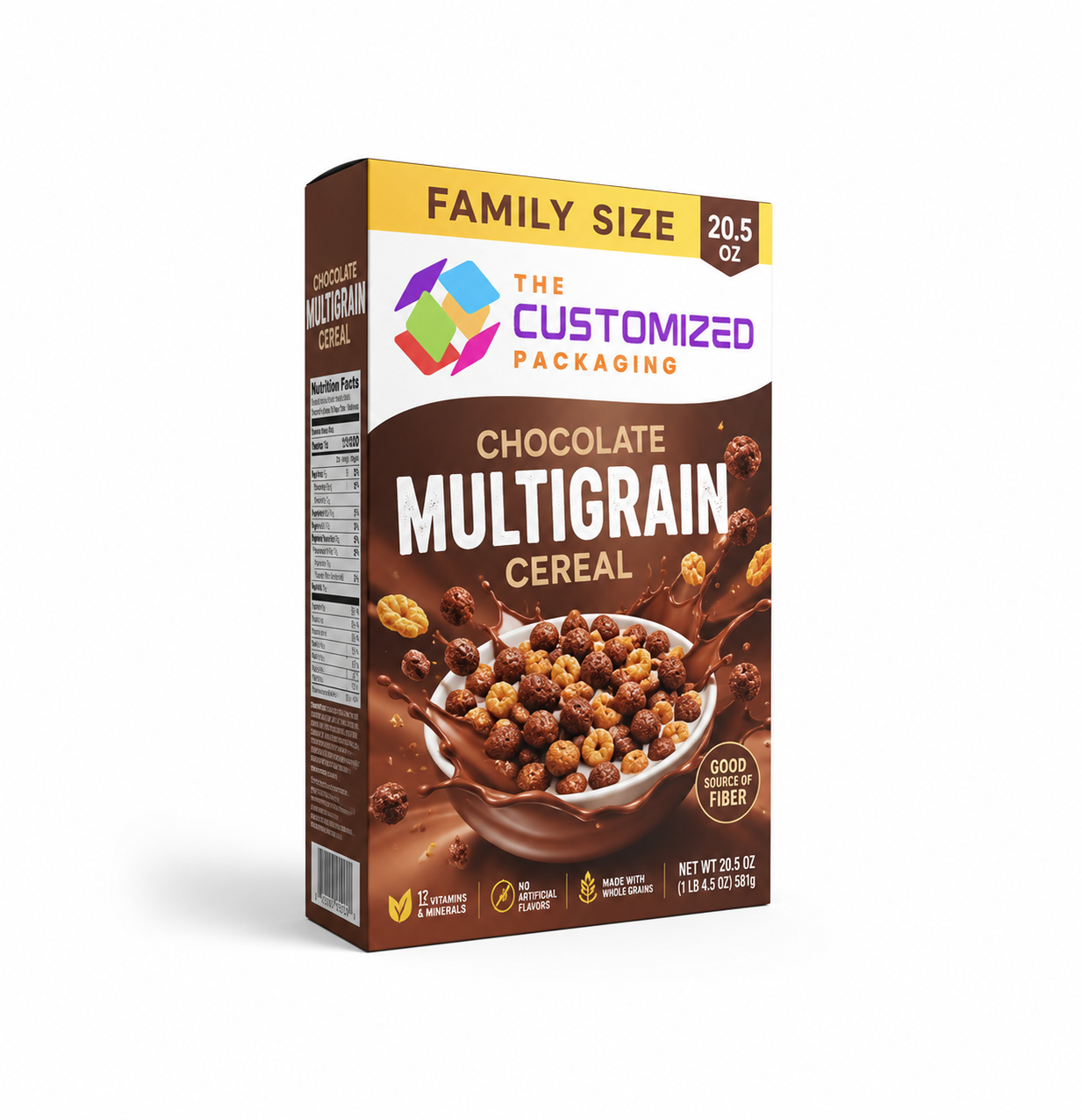
An upright folding carton provides broad front and back panels with narrower side panels. The layout must account for the filled bag, top and bottom closures, shelf orientation, and required information panels.
Reinforced and Multipack Cartons
Heavier cereal products or multiple sealed units may need a stronger board or reinforced bottom. The structure should be chosen around the actual total weight and packaging arrangement rather than simply the product category.
Window and Dispensing Features
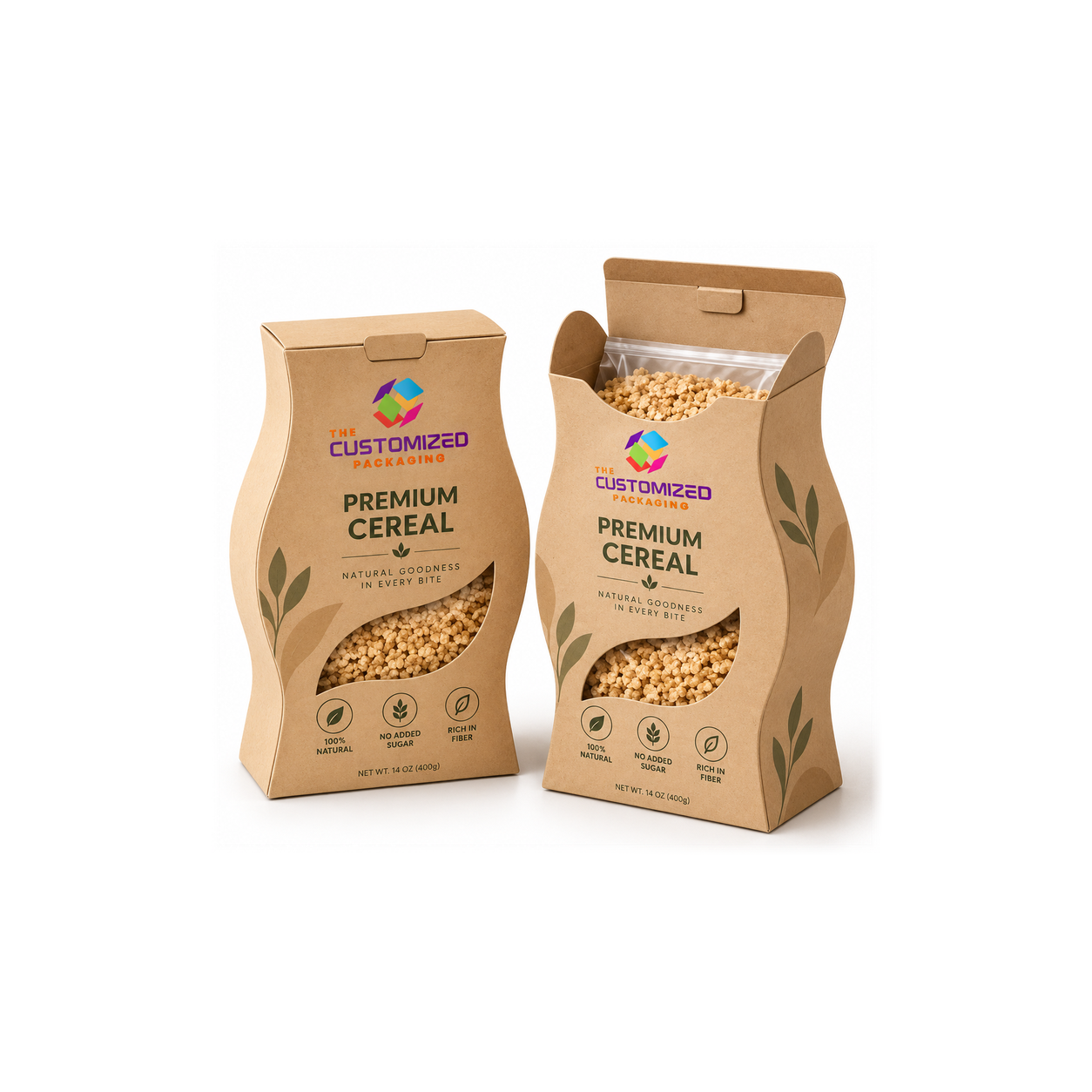
Selected die-cut windows or dispensing elements may be possible, but they require evaluation of the board, primary bag, and product access. An opening in the outer carton must not compromise the primary food seal.
Paperboard and Kraft Material Selection
Material selection influences printing, stiffness, folding performance, package appearance, and cost. White paperboard can support detailed artwork and food photography, while kraft provides a brown or natural-looking surface.
The selected board should be appropriate for the carton dimensions, packed weight, and handling conditions. Larger cartons may need additional stiffness even when the cereal product itself is relatively lightweight.
Cereal Carton Material Comparison
| Material | Possible Use | Important Requirement |
|---|---|---|
| SBS paperboard | Full-color retail cartons | Print and fold quality |
| Folding boxboard | Standard retail packaging | Appropriate board grade |
| White kraft | Branded cartons | Surface and print compatibility |
| Natural kraft | Minimalist paperboard cartons | Color contrast and legibility |
| Selected recycled-content board | Specified secondary packaging | Document actual fiber composition |
| Microflute corrugated | Selected reinforced packages | Structural and production feasibility |
The appearance of a paperboard cereal carton does not prove the complete packaging system is recyclable, biodegradable, compostable, or certified.
Measuring the Sealed Inner Bag for a Custom Cereal Carton
The correct measurements come from the primary food package after filling and sealing. Empty flat bags may change shape considerably once filled with cereal.
Required Inner-Bag Measurements
Measure the primary food package after it has been filled and sealed. The carton specification should include:
- Filled length and width: The actual footprint of the finished inner package.
- Maximum filled height or thickness: Include natural bulging and the intended bag orientation.
- Sealing seams and closures: Allow space without placing unnecessary pressure on the seals.
- Total packed weight: Include the food product, primary package, and any additional contents.
Where cereal settles or the filled bag changes shape, a representative production sample can help confirm the final clearance. The carton should close without unnecessarily compressing the primary package.
If additional leaflets, promotional items, or separate food packs are included, their space requirements should be accounted for before approving the dieline.
Custom Printed Cereal Boxes with Logo
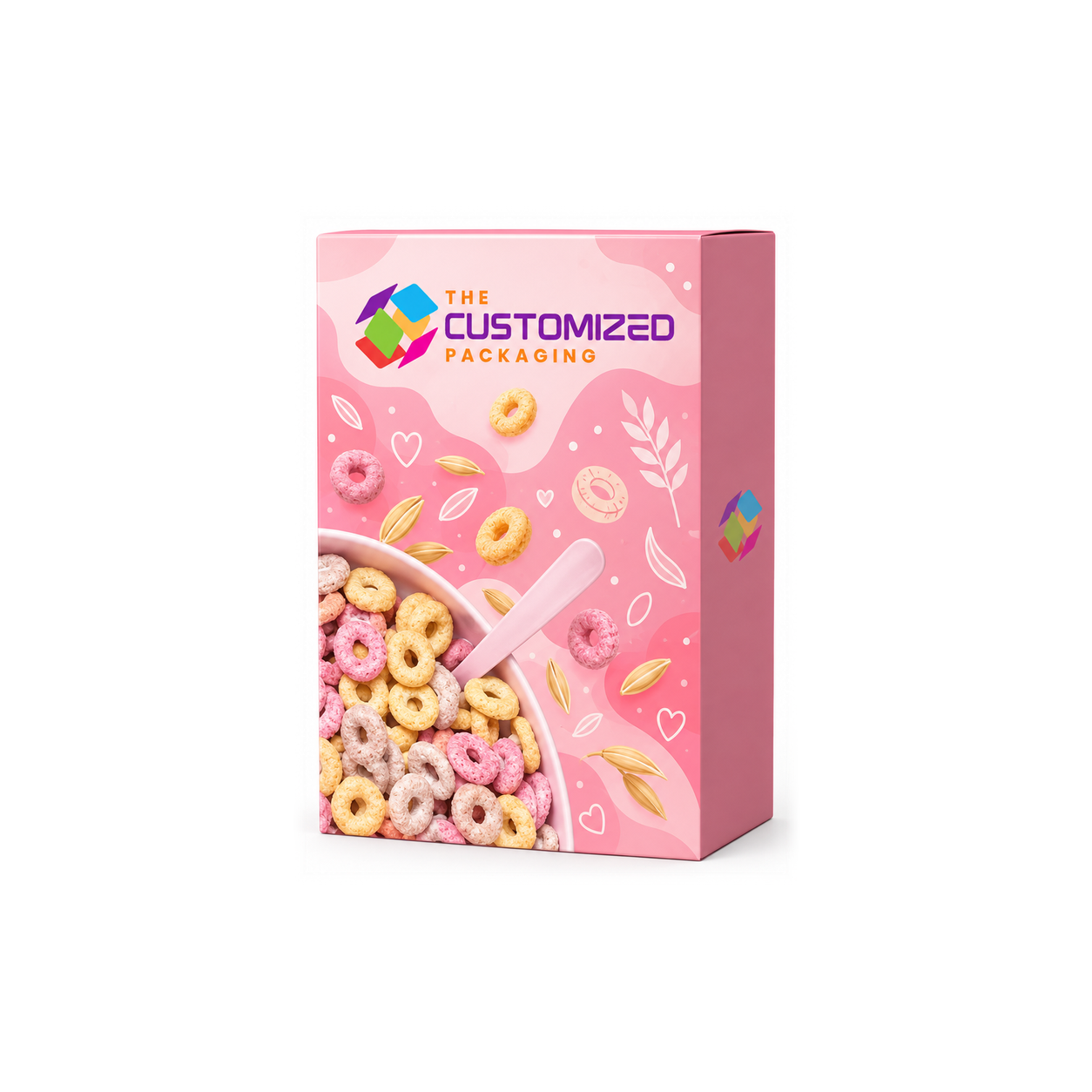
Custom printed cereal boxes can feature brand logos, product names, approved food photography, flavor graphics, nutritional information, barcodes, and promotional messages.
Digital or offset printing may be considered depending on the board, graphics, quantity, and production specifications. Exterior panels should be organized so branding and required information remain clear.
Decorative print coverage must not obscure important nutrition, ingredient, allergen, or other product statements approved by the food business.
Nutrition Facts, Ingredients, and Allergen Information
Depending on the food and intended market, cereal cartons may require Nutrition Facts, ingredient lists, allergen declarations, net quantity, business information, and other labeling elements.
TCP can print artwork supplied and approved by the responsible food business. The producer or its regulatory adviser must determine the applicable labeling requirements and verify all product and health-related claims.
Printing a cereal carton does not establish FDA approval, confirm organic or gluten-free status, or validate ingredient and allergen statements.
Barcodes, lot details, and any variable coding should be planned into the printable panels before production approval.
Windows, Cutouts, and Dispensing Features
Some cereal carton designs may include a die-cut opening or window to reveal part of the sealed primary pack. If a transparent film is used, the material and its compatibility with the finished carton should be reviewed.
Dispensing features require careful assessment of how the customer accesses the product. A cutout in the secondary carton does not create a validated food-contact dispensing system.
Tear strips, reclosures, or tamper-evident components should only be offered where the actual construction and manufacturing process can support them.
Cereal Box Inserts and Multipack Arrangements
A single cereal bag may not need an internal insert. Multipacks, sample assortments, and promotional collections may benefit from dividers or compartments that organize separate sealed units.
Possible Multipack Components
- Paperboard dividers: Separate different sealed food products.
- Fitted compartments: Hold individual cereal packs in a defined arrangement.
- Folded supports: Help position products within larger cartons.
- Promotional-card spaces: Reserve space for non-food inserts without affecting the sealed primary packages.
The arrangement should be evaluated with all items included. Heavier assortments may require additional board support and a suitable bottom closure.
Retail Display, Storage, and Distribution
Retail cereal packaging should provide a clear shelf-facing presentation and a practical form for stacking, stocking, and customer handling. Side panels can help distinguish individual flavors or package sizes within a brand family.
For wholesale distribution, retail cartons may be packed into protective outer cases. Those cases should be selected for the actual number of cereal cartons, total packed weight, and expected stacking conditions.
A standard cereal folding carton should not be treated as a standalone parcel shipping box without an appropriate packaging design and validation.
Food Packaging Barriers and Environmental Limitations
The primary bag or pouch is responsible for the required food-contact, freshness, moisture, and oxygen protection. A decorative treatment on the outer carton should not be described as making the complete food package leak-proof.
Grease-resistant printing or a coated outer paperboard does not independently establish a suitable barrier for direct food contact. Any direct-contact material requires verification for its intended use.
Environmental claims should account for the outer carton, inner bag, films, windows, labels, coatings, and adhesives. Different parts of the package may have different collection or disposal requirements.
Wholesale Cereal Box Pricing and Ordering
Wholesale cereal box pricing depends on finished carton dimensions, material, print coverage, SKU variations, structural details, inserts, order quantity, and shipping destination.
The minimum production quantity should be confirmed for the chosen box and printing process. Multiple cereal varieties may require separate artwork files and additional setup.
Request a Cereal Carton Quote
Submit the confirmed primary-pack dimensions together with the approved branding and food-labeling artwork, number of SKU designs, required quantity, and delivery details.
For a preliminary budget, use our Custom Box Packaging Cost Calculator. Final pricing is established after the actual structure and production requirements have been reviewed.
Preparing cereal packaging for retail? Confirm your finished inner-bag specification and printed variants so the carton layout can be evaluated for shelf presentation, information-panel space, and efficient packing.
These cartons are generally designed around a suitable sealed inner bag or other primary food package. The primary container provides the relevant food-contact and freshness barrier. Any direct-contact use requires materials specifically verified for that product and application.
Measure the finished filled and sealed inner bag, including its length, width, height, seams, and product weight. The carton should accommodate the primary package without excessively compressing its seals.
Yes. TCP can print approved artwork, including logos, ingredients, Nutrition Facts, allergen declarations, and barcodes. The responsible food business must verify the regulatory content and accuracy of all product statements.
Selected windows or dispensing features may be possible. Their feasibility depends on the box structure and inner package, and they must not compromise the sealed primary container or imply unverified food-contact performance.
Pricing depends on the carton size, material, printing, artwork variations, optional features, order quantity, and destination. Share the filled inner-bag measurements and approved artwork for a confirmed quotation.
Related Products









Order Custom Cereal Boxes from The Customized Packaging
We manufacture Custom Cereal Boxes for businesses that need reliable product protection, accurate printing, and professional packaging for retail, ecommerce, storage, or shipping. Each box can be customized by size, material, structure, printing, coatings, finishes, inserts, and order quantity.
Share your artwork and quantity targets for Custom Cereal Boxes and we will recommend the most cost-effective structure for your timeline. or speak with a packaging expert.